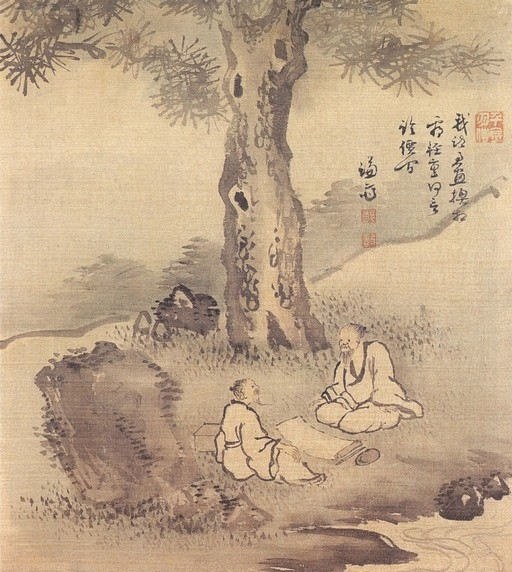
Poem and Painting Exchanged, Seen Together (詩畵換相看, 시화환상간)
Yi Byeong yeon (李秉淵, 이병연), 1741
我詩君畵換相看
輕重何言論價間
詩出肝腸畵揮手
不知雖易更雖難
My poems and your paintings, we trade them and gaze on each other's work. How could their weight be spoken of, or their worth be set in price. A poem is drawn up from the liver and the gut, a painting flung out by a moving hand. Which is the lighter labor, which the harder, I cannot say.
*Even after King Sejong created Hangul in 1443, Joseon continued to use Chinese characters alongside it. Hangul was designed as an easier script for commoners, but the scholar official class continued to study Chinese, and the poems Jeong Seon and Yi Byeong yeon exchanged were themselves written in it. This is why Chinese characters appear throughout this piece.
In the early autumn of 1740, during the reign of King Yeongjo, in Korea's old and long standing royal dynasty, Joseon (朝鮮, 조선, 1392 to 1897), the painter Jeong Seon (鄭敾, 정선) was appointed magistrate of Yangcheon (양천) county in Gyeonggi province. Prior to this departure, Jeong Seon and his lifelong friend, the poet Yi Byeong yeon (李秉淵, 이병연), entered into an agreement. They would trade their work with each other from a distance. Jeong Seon would send paintings of scenic sites near his new post, and Yi Byeong yeon would answer with poems. The pact itself was given a name, sihwahwansanggan (詩畵換相看, 시화환상간), meaning poem and painting exchanged, seen together.
The two men were natives of Seochon (西村, 서촌), the neighborhood now spanning Cheongun dong and Ogin dong in Seoul, and had grown up there together. Their contemporaries already spoke of them as a pair. The painting belonged to Gyeomjae (謙齋, 겸재), Jeong Seon's studio name, they said, and the poetry to Sacheon (槎川, 사천), Yi Byeong yeon's studio name. Yi Byeong yeon was said to have written somewhere between thirteen thousand and thirty thousand poems in his lifetime, and to have worked at his desk for days at a stretch, tugging at his beard as he composed, so much so that little beard was left on his face by the time he emerged. Even so, he was known well beyond scholarly circles, his poems reaching children and commoners alike. A contemporary man of letters, Bak Sahae (朴師海, 박사해), described the pair this way: Sacheon's poem is a painting, and Gyeomjae's painting is a poem.
The poem above comes from the letter Yi Byeong yeon sent at the founding moment of this agreement, and it opens the Gyeonggyo Myeongseungcheop(京郊名勝帖, 경교명승첩). The poem ends without declaring either art superior. Poetry and painting are treated as two forms of labor, each drawn out of the body in its own way. Jeong Seon inscribed the poem's first two lines directly onto the painting itself. In this way, the painting, a picture of the friendship, also enacts the friendship's own method, poem seeping into painting, painting seeping into poem.
In the painting, two old men sit beneath a pine tree by a stream, a scroll spread open between them, their formal hats set aside. The seated figure shown face on is thought to be Yi Byeong yeon, and the one seen only from the side, with a notably proud profile, is thought to be Jeong Seon himself. The figural rendering is spare and unadorned, with no bright color and no dramatic composition. And yet scholars have noted that this very plainness holds, in condensed form, the accumulated discipline of Jeong Seon's lifetime at the brush.
Jeong Seon's principal contribution to the history of Korean painting lies in his consolidation of jingyeong sansuhwa (眞景山水畵, 진경산수화), true view landscape painting. Where earlier Joseon landscape painting had largely reproduced idealized compositions derived from Chinese painting manuals, Jeong Seon established a method of rendering the actual topography of Korea as he had directly observed and traversed it. Sihwahwansanggan may be read as a variation on this same principle. What the painting represents is not an idealized notion of friendship but a specific, historically enacted friendship, an actual pact that was actually kept.
Gyeonggyo Myeongseungcheop (京郊名勝帖, 경교명승첩) by Jeong Seon was designated Korean Treasure No. 1950 on December 26, 2017. According to the official record of the Korea Heritage Service, the album as a whole was produced between 1741 and 1759, the year of Jeong Seon's death. Regarding the specific execution date of Sihwahwansanggan itself, sources diverge, with 1741 given in one account and 1754 in another.
Jeong Seon marked most of the works in this album with a personal seal reading cheongeum multjeon (千金勿傳, 천금물전), "not to be given away even for a thousand pieces of gold," a small but telling declaration of how highly he prized the collaboration. Scholars group the thirty three paintings in the album into three sets. Eight depict scenes from a Han River excursion unrelated to Yi Byeong yeon. A second set, known as the Ten Views of Yangcheon (陽川十景, 양천십경), carries Yi Byeong yeon's poems alongside views of the area surrounding Jeong Seon's post. A third set was produced under a related pact the two men called sigeohwaraejiyak (詩去畵來之約, 시거래화지약), "when the poem goes, the painting comes," and it is this set that most directly visualizes their friendship. Paintings such as Hongwan miju (紅欄尾洲, 홍관미주), Changmyeong nangbak (滄溟浪泊, 창명낭박), and Haengju ildo (幸州一棹, 행주일도) commemorate a specific episode in the spring of 1741, when Yi Byeong yeon attempted to sail from Haengju (幸州, 행주) to visit Jeong Seon at his post. Gosan sangmae (孤山賞梅, 고산상매) expresses a wish to view plum blossoms together, while Eocho mundap (漁樵問答, 어초문답) stages the easy conversation of two men who understood one another completely. Two further paintings in this group, Chokjae jesi (燭齋題詩, 촉재제시) and the self portrait discussed below, Dokseo yeoga (讀書餘暇, 독서여가), are thought to be likenesses of the two friends themselves, Yi Byeong yeon and Jeong Seon respectively.
Fig. 1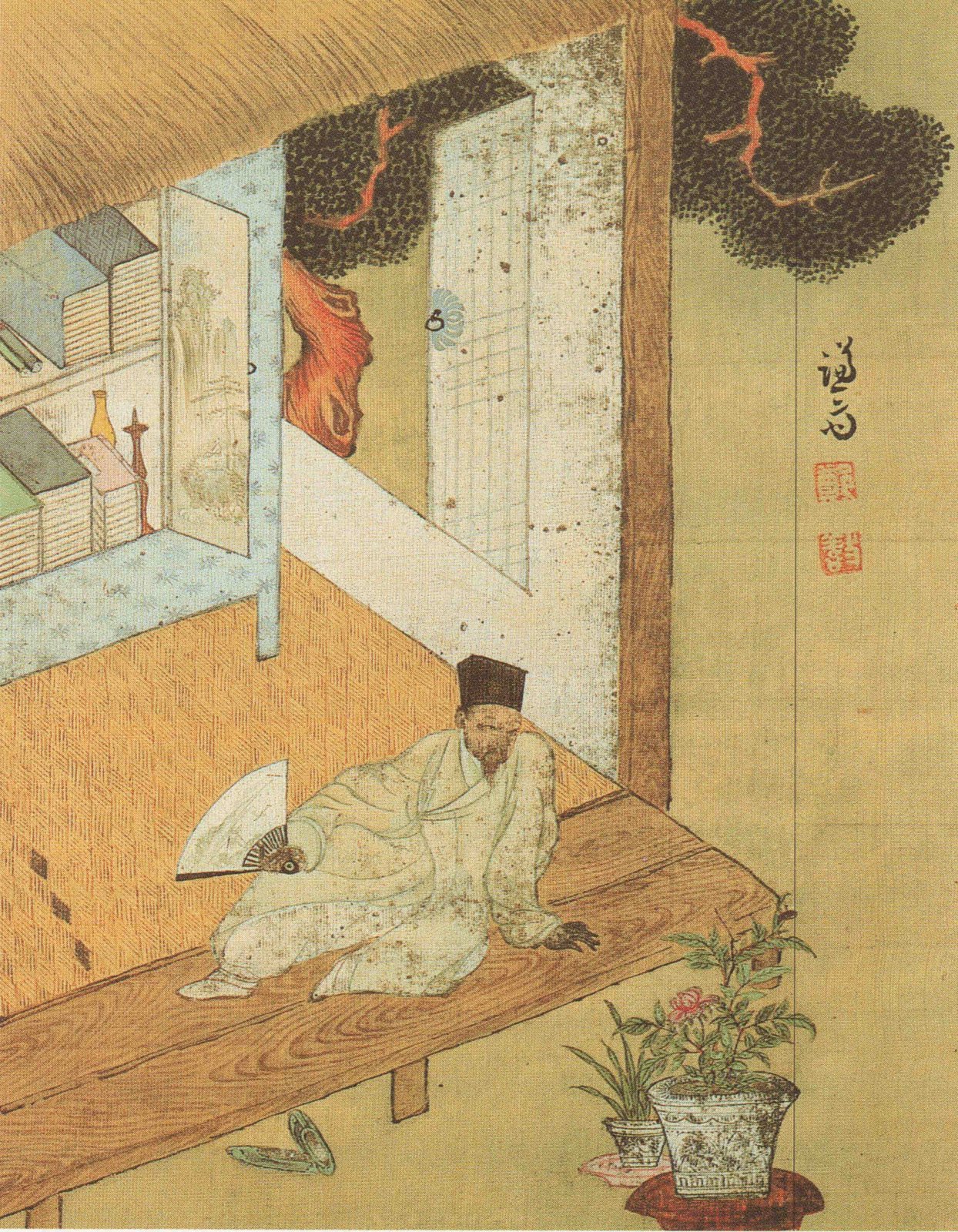
Jeong Seon (鄭敾, 정선), Taking a Rest After Reading Books (讀書餘暇, 독서여가), 18th century, believed to be a self portrait
Said to depict the painter himself, pausing in a moment of rest from reading. Here, for the first time in this piece, we meet the face of the man who traded paintings for poems.
Image courtesy of Wikimedia Commons (Public Domain)
Yi Byeong yeon's role in this friendship extended beyond poetry. He also served as an informal broker for Jeong Seon's paintings, a function of real consequence in a society where a scholar official painting for sale risked losing social standing. Surviving correspondence indicates that acquaintances seeking Jeong Seon's work often approached him through Yi Byeong yeon rather than directly, and one account, recorded in Sindon Bok's Haksan haneon (鶴山閑言, 학산한언), claims Yi Byeong yeon arranged for Jeong Seon's paintings to be sold to travelers departing for China. A contemporary collector, Yu Eom (兪拑, 유엄), is recorded as saying that the poems and paintings the two men produced together were so rare in their age that collectors regarded them as gems or gold. This intermediary role suggests that Yi Byeong yeon's friendship functioned not only as emotional companionship but as practical infrastructure, easing Jeong Seon's discomfort with the commerce of art and making possible the sustained productivity of his later career.
The friendship did not end there. Jeong Seon's late masterwork, Clearing After Rain on Mount Inwang (仁王霽色圖, 인왕제색도), also grew out of that same sixty year bond with Yi Byeong yeon. To render the weight of the rain soaked rock face, Jeong Seon applied dense ink in repeated, top down strokes, setting the blackened ridges and trees against the pale fog to bring out the mountain's contours in sharp relief. Among some four hundred surviving works by Jeong Seon, it is widely regarded as his most accomplished masterpiece.
Fig. 2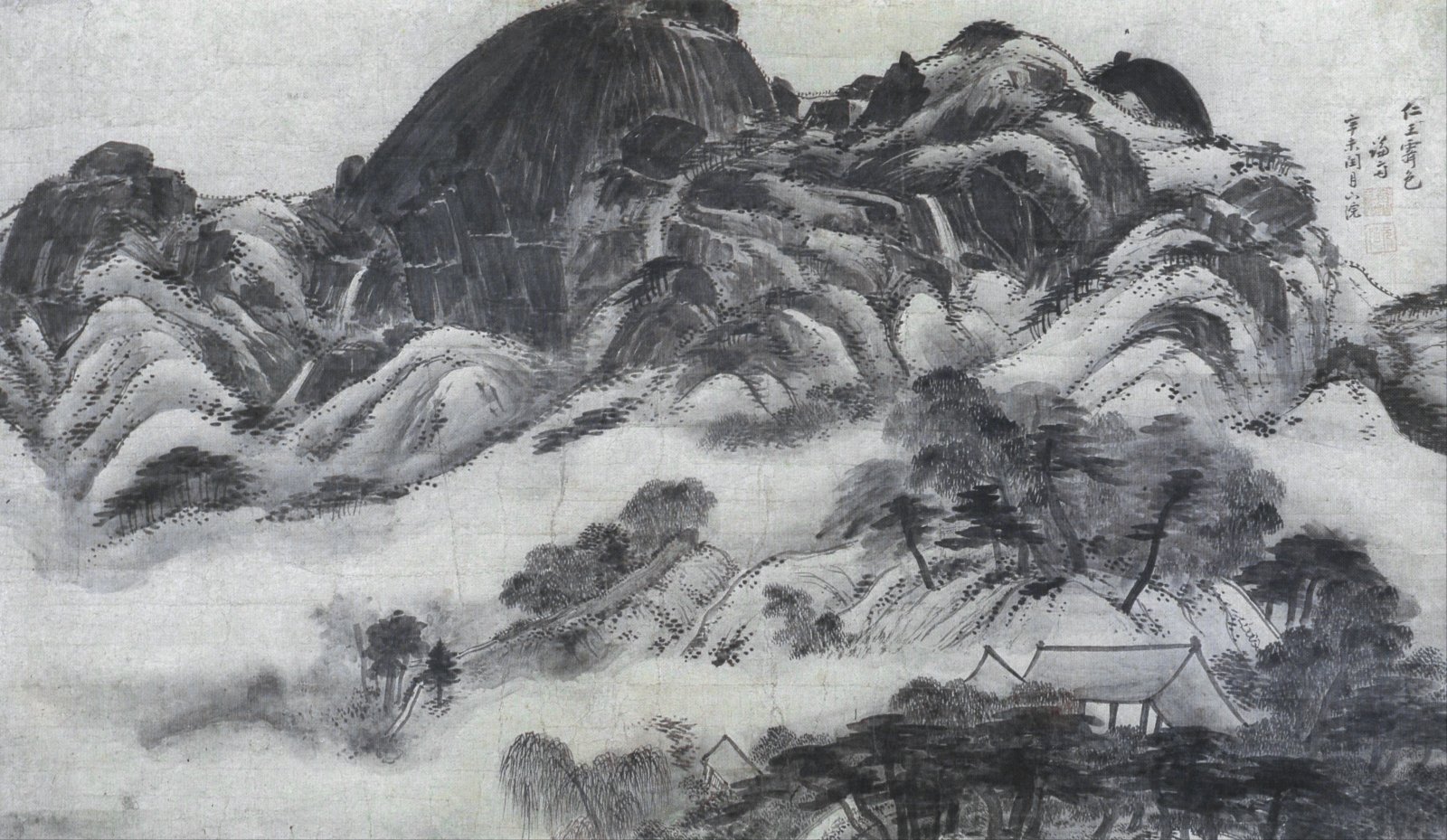
Jeong Seon (鄭敾, 정선), Clearing After Rain on Mount Inwang (仁王霽色圖, 인왕제색도), 1751, ink on paper, 79.2 x 138.2 cm, National Treasure, Ho Am Art Museum (Samsung Foundation of Culture); following the 2021 donation of the Lee Kun-hee Collection, some current records list the work under the National Museum of Korea
Jeong Seon's late masterwork, rendering Mount Inwang after rain in dense ink. His sixty year friendship with Yi Byeong yeon runs through the whole of his career, this painting included.
Image courtesy of Wikimedia Commons (Public Domain)
Jeong Seon's full ambition is most visible in Complete View of Mount Geumgang (金剛全圖, 금강전도). Painted in 1734, when Jeong Seon was fifty nine, the work renders the whole of Naegeumgang (內金剛, 내금강), the Inner Geumgang range, from a bird's eye vantage point (俯瞰法, 부감법). Twelve thousand peaks fill the composition, with Birobong, the highest peak, set at the rear, from which the Manpokdong valley splits the scene into left and right. On the right, sharp, upright peaks are rendered in forceful vertical strokes, while on the left, softer, more densely wooded slopes are built up with dotted brushwork (米點, 미점). Among Jeong Seon's many paintings of Mount Geumgang, this one is regarded as the largest and finest.
Fig. 3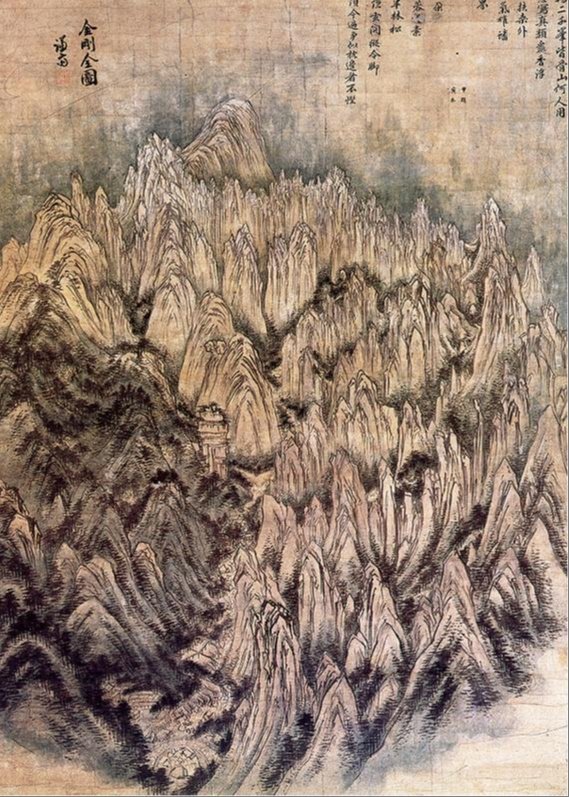
Jeong Seon (鄭敾, 정선), Complete View of Mount Geumgang (金剛全圖, 금강전도), 1734, ink on paper, National Treasure
Jeong Seon's sweeping view of the Inner Geumgang range from above, twelve thousand peaks filling the canvas, sharp rock faces on the right set against softer, wooded slopes on the left.
Image courtesy of Wikimedia Commons (Public Domain)
In the upper right corner of Complete View of Mount Geumgang, Jeong Seon inscribed his own title, pen name, and a brief colophon directly onto the painted surface, a gesture that was less personal idiosyncrasy than shared convention across literati painting (munhinhwa, 文人畵, 문인화) of the period. Image and language occupying a single surface was, for painters of his generation, a habit of thought rather than an experiment.
But the two need not share a surface at all. Jeong Seon and Yi Byeong yeon composed on entirely separate sheets, and still, in the moment their work answered one another, the same principle held, a poem containing a painting, a painting containing a poem. The colophon shows this union bound within a single surface. Sihwahwansanggan shows the same union sustained across a distance. Neither is more essential than the other. Together, they trace the full range the relation between image and word can take.
It is this whole range that Ekphra holds as its founding principle. Under the name Art Meets Word, we regard painting and poem sharing a single page, and painting and poem living apart yet answering one another across distance, as equally valid expressions of a single spirit.
Jeong Seon's boldness was not confined to mountains. Bakyeon Falls (朴淵瀑布, 박연폭포) renders an actual waterfall near Gaeseong (開城, 개성) in a tall, narrow composition, its water plunging straight down the sheet in a dramatic vertical drop.
Fig. 4
Jeong Seon (鄭敾, 정선), Bakyeon Falls (朴淵瀑布, 박연폭포), 18th century, ink on silk, 119.5 x 52.2 cm, private collection (Yi Ubok)
A true view rendering of an actual waterfall near Gaeseong, its plunging vertical composition showing the same boldness of scale found across Jeong Seon's work.
Image courtesy of Wikimedia Commons (Public Domain)
Jeong Seon had, alongside him, another intellectual companion, the literati painter Jo Yeongseok (趙榮祏, 조영석, 1686 to 1761). He lived in the same neighborhood as Jeong Seon and Yi Byeong yeon, studied under the same teacher, Kim Changheup (金昌翕, 김창흡), and left numerous colophons on Jeong Seon's paintings over the course of a long, mutually observant friendship. Notably, Jo Yeongseok twice declined commissions to paint royal portraits (御眞, 어진), a mark of the strength of his self identification as a scholar rather than a painter. This reluctance to foreground the identity of painter seems to reflect the broader hierarchy of Joseon society, one that placed the literatus above the artisan painter. Yet in the author's assessment, Jo Yeongseok's paintings show an observational sharpness fully equal to Jeong Seon's, and arguably surpassing it. If he restrained his own talent within the bounds of scholarly dignity, that same talent appears to have continuously sharpened Jeong Seon's own work from close at hand. This literati painter's story is one the author hopes to take up more fully in a future piece.
Fig. 5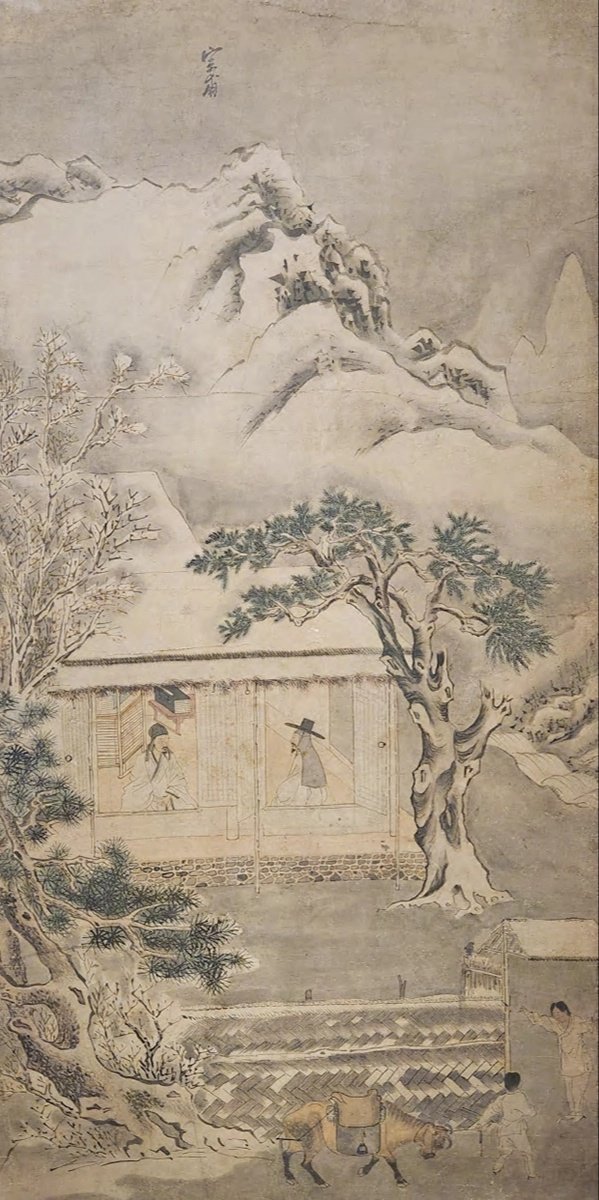
Jo Yeongseok (趙榮祏, 조영석), Visiting a Friend in Snow (雪中訪友圖, 설중방우도), mid 18th century, private collection, image courtesy of the National Museum of Korea
An old Chinese motif, a visit to a friend on a snowy day, remade by Jo Yeongseok as an actual Joseon scene, complete with an ox led servant and a raised gate.
Jeong Seon's range extended well beyond the works discussed above. Two further paintings offer a brief glimpse of that wider body of work: one honoring a scholar of an earlier generation, the other a coastal view from among his celebrated views of the eastern shore.
Fig. 6 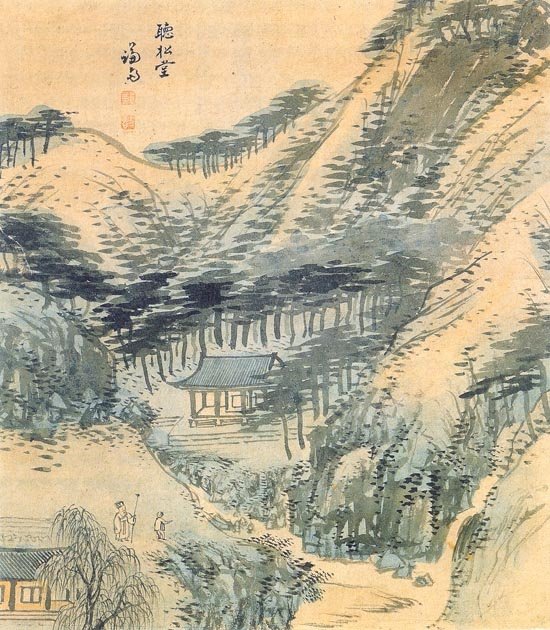
Jeong Seon (鄭敾, 정선), Cheongsongdang (聽松堂, 청송당), 18th century, light color on paper, Kansong Art Museum
A view of the reading pavilion built for Seong Su chim, a noted scholar of the mid Joseon period, nestled among dense pine covered slopes.
Image courtesy of Wikimedia Commons (Public Domain)
Fig. 7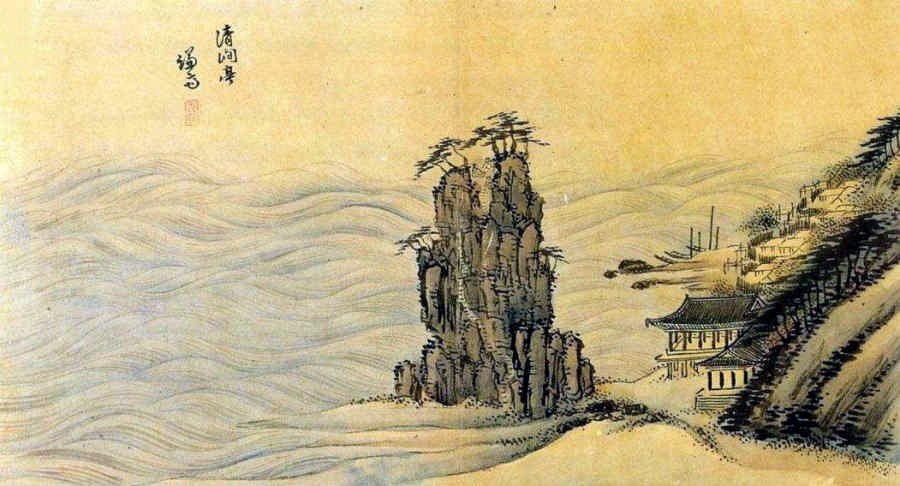
Jeong Seon (鄭敾, 정선), Cheongganjeong (淸澗亭, 청간정), c. 1750, one of the Eight Views of Gwandong (關東八景, 관동팔경), Kansong Art Museum
A coastal pavilion on Korea's eastern shore, wind bent pines and layered rock set against a wide, wave patterned sea.
Image courtesy of Wikimedia Commons (Public Domain)
Behind a great painter, there is often a companion of this kind, a fellow writer, a fellow painter. In modern language, we might call this a connection. But this is not a matter of mere acquaintance or convenient networking. The rich exchange itself, watching each other's work, commenting on it, sometimes clashing over it, appears to be what sharpens an artist's practice.
This pattern is familiar in Western art history as well. Van Gogh and Gauguin shared a brief, difficult cohabitation in the Yellow House in Arles, and each left a lasting mark on the other's style. Picasso and Matisse remained lifelong rivals and colleagues, buying and studying each other's work, sustaining an intellectual dialogue across decades. Braque and Picasso, developing Cubism together, later described that period as being roped together like two mountain climbers. In every case, the friend's talent proved to be no lesser than the other's.
The same held true beside Jeong Seon, first with Yi Byeong yeon, and then with Jo Yeongseok. A great painter is rarely made alone. This is why we hope Ekphra can become that same kind of encounter for one another.
A Note from Ekphra
The name ekphra derives from the ancient Greek ekphrasis, the old rhetorical art of putting an image into words. We have adopted this term for the platform in the hope of reviving it as a living practice, a site where painting and poem answer one another.
It was a genuine pleasure to discover that this same spirit had already existed, nearly three hundred years ago, in the story of one of Korea's most beloved painters. Jeong Seon and Yi Byeong yeon spent a lifetime trading work back and forth, painting going out, poem coming back, and back again, never asking which art was greater or harder. They simply held each other's labor as equal in weight.
Perhaps a poet fills something a painter alone cannot. When Jeong Seon sent out the mountains and rivers he had painted, and Yi Byeong yeon answered at once with a poem, what comfort must that response have been. The work of making is, by nature, a solitary act. But to have someone see what you have made and take it up again in their own language, that is not mere appreciation. It becomes another source of energy to keep working.
We hope Ekphra can be a bridge toward that kind of encounter, a painter and a poet who might never have met, meeting instead through the work itself. Just as this friendship encouraged and grew both of their lifetimes' work, we hope this blog, and this platform, can grow the same way, poem and painting and art, exchanged and seen together. And we hope to keep finding this same thread, wherever it appears, across every era and every country.
References
Korea Heritage Service. "Jeong Seon pil Gyeonggyo Myeongseungcheop." Korea Heritage Portal. Registered December 26, 2017.
Korea Heritage Service. "Jeong Seon pil Inwangjesaekdo." Korea Heritage Portal.
Korea Heritage Service. "Jeong Seon pil Geumgangjeondo." Korea Heritage Portal.
Kim, Gahee (김가희). "Reconsidering the Friendship of Jeong Seon and Yi Byeong yeon: Centering on the Sigeohwaraejiyak Pact in Gyeonggyo Myeongseungcheop." 2019.
National Museum of Korea and Cultural Heritage Administration. Exhibition catalogue, New Treasures Have Arrived: Newly Designated National Treasures and Treasures, 2017 to 2019.
Lee, Ki hwan (이기환). "The Greatest Bromance of Joseon: The Collaboration of Gyeomjae and Sacheon." Kyunghyang Shinmun, November 15, 2017.
Choe, Wansu (최완수). "Gyeomjae Jeong Seon's Views of Hanyang, no. 32: Sihwahwansanggan." Donga Ilbo, September 17, 2009.
Kim, Seungik (김승익). "Departing from Traditional Iconography to Capture Joseon's Modest Daily Life: National Museum of Korea Masterpieces of Painting and Calligraphy, no. 3, Jo Yeongseok's Visiting a Friend in Snow." April 8, 2026.
The Academy of Korean Studies. "Jeong Seon pil Gyeonggyo Myeongseungcheop," "Jo Yeongseok." Encyclopedia of Korean Culture.
About the Author
This piece was prepared by Laird Art Gallery. The author, Young Hee Sung (성영희), is a painter and the founder of Laird Art Gallery and Ekphra. She once lived in Yangcheon, Seoul, before later relocating to Canada.
Postscript
While gathering material for this piece, the author came across a source introducing the poems Yi Byeong yeon wrote for ten paintings of the Yangcheon area from Gyeonggyo Myeongseungcheop. The final line of the tenth, Sunset Beacon at Anhyeon (鞍峴夕峰, 안현석봉), reads as follows in the original:
有味老淸時
捲簾山色晩
笑看一點星
飽喫陽川飯
There is savor even in the clear hour of growing old. I raise the blind, and the mountain's color dims toward evening. I smile, watching one point of starlight, having eaten my fill of Yangcheon's rice.
The Yangcheon that Jeong Seon recorded in this poem is the same ground where the author lived until 2006.