← Paint
PAINT
Oil Paint
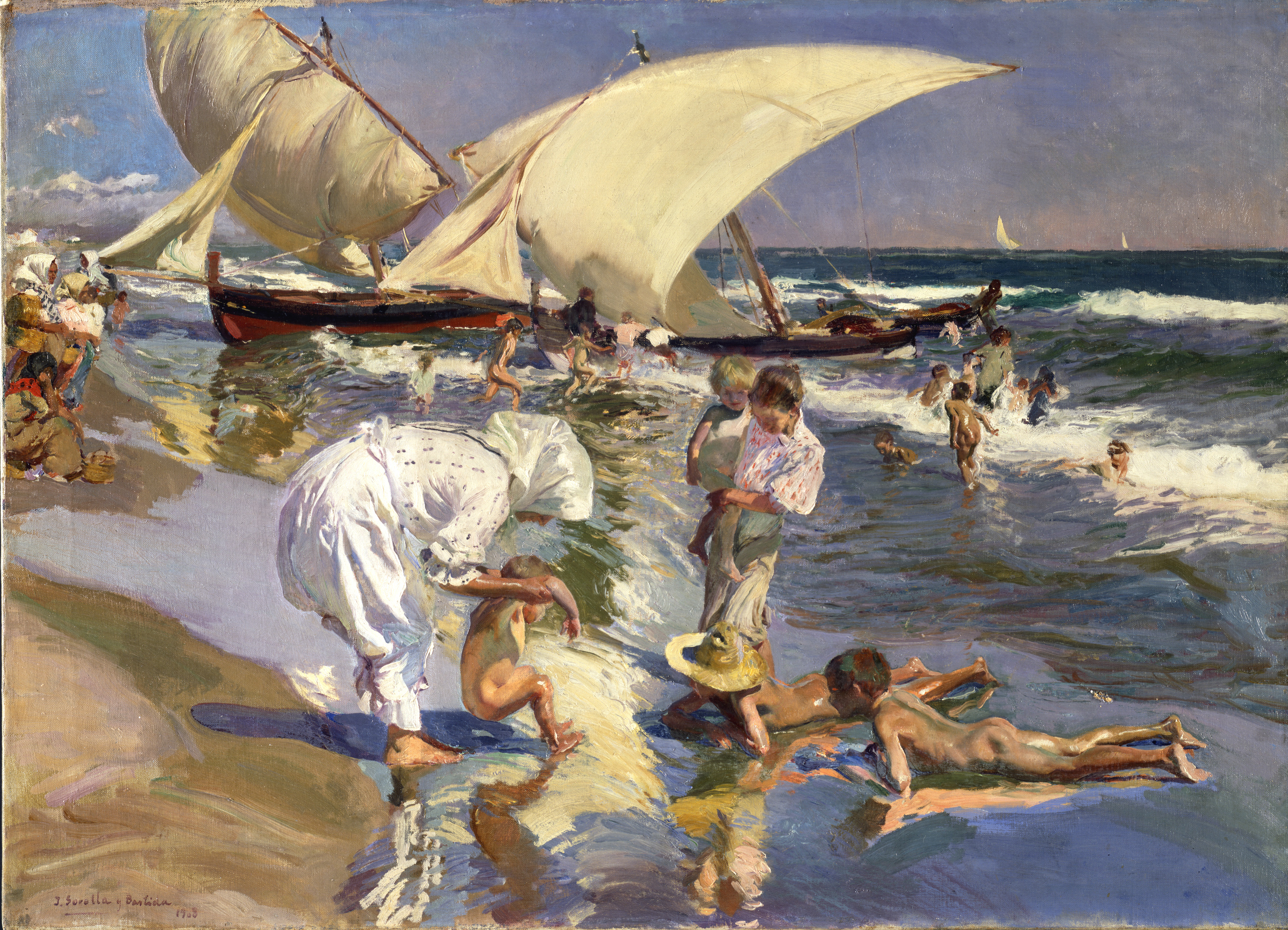
Joaquín Sorolla · Beach of Valencia by Morning Light · 1908 · Oil on canvas · Public Domain
Oil paint is a slow-drying medium consisting of pigment particles suspended in a drying oil — most commonly linseed, walnut, or poppy oil. It has been the dominant painting medium in Western art for over six centuries, prized for its unmatched range of optical effects: from the luminous translucency of layered glazes to the sculptural physicality of impasto. No other medium offers oil paint's combination of extended working time, blendability, chromatic depth, and archival permanence.
What makes oil paint unlike anything else is time. The slow drying — days to weeks depending on the pigment and oil — is not a limitation. It is the medium's greatest gift. You can push paint across the canvas for hours. You can blend edges until they disappear. You can scrape back and begin again. You can glaze transparent colour over dried layers and build luminosity that goes deeper than the surface. Every optical effect that made the Old Masters impossible to ignore was built on this one property.
The fat over lean rule governs everything in oil painting: each successive layer must contain more oil than the one beneath, or the faster-drying lower layers will pull at the slower-drying upper ones and the paint film will crack. This is not a technicality. Paintings that ignore it fail structurally within decades. Paintings that follow it last centuries.
Oil paint rewards patience, planning, and a tolerance for uncertainty. The medium does not dry the same way twice — humidity, temperature, pigment chemistry, and ground absorbency all affect the result. Learning oil paint means learning to read the surface and respond to what is actually there, not what you planned.
What makes oil paint unlike anything else is time. The slow drying — days to weeks depending on the pigment and oil — is not a limitation. It is the medium's greatest gift. You can push paint across the canvas for hours. You can blend edges until they disappear. You can scrape back and begin again. You can glaze transparent colour over dried layers and build luminosity that goes deeper than the surface. Every optical effect that made the Old Masters impossible to ignore was built on this one property.
The fat over lean rule governs everything in oil painting: each successive layer must contain more oil than the one beneath, or the faster-drying lower layers will pull at the slower-drying upper ones and the paint film will crack. This is not a technicality. Paintings that ignore it fail structurally within decades. Paintings that follow it last centuries.
Oil paint rewards patience, planning, and a tolerance for uncertainty. The medium does not dry the same way twice — humidity, temperature, pigment chemistry, and ground absorbency all affect the result. Learning oil paint means learning to read the surface and respond to what is actually there, not what you planned.
Properties ▾
Binder: Linseed oil (most common), walnut oil (slower drying, less yellowing), poppy oil (slowest drying, palest)
Drying: Oxidative polymerisation — not evaporation. Touch-dry in days to weeks; fully cured in months to years
Pigment load: Artist grade typically 40–70% pigment by volume
Lightfastness: Excellent in artist-grade paints; ASTM I or II ratings
Fat over lean rule: Each layer must contain more oil than the layer beneath to prevent cracking
Mediums: Linseed oil (increases gloss/drying), turpentine/odourless mineral spirits (thinner/faster drying), stand oil (increases flow, reduces brushstrokes), alkyd mediums (accelerate drying)
Supports: Canvas (linen or cotton), wood panel, copper, paper (oil-primed)
Ground: Traditionally lead white in oil; modern: titanium white acrylic gesso (must be oil-primed for best adhesion)
Mediums ▾
Linseed Oil
The most widely used oil medium. Increases gloss, transparency, and flow. Dries to the strongest, most durable film of all drying oils. Avoid for whites and pale colours — yellows over time.
Stand Oil: Heat-thickened linseed oil with exceptional self-leveling properties. Reduces brush marks to a smooth enamel-like surface. Classic glazing medium when mixed 1:1 with turpentine. Yellows less than regular linseed.
Walnut Oil: The clearest, most colourless drying oil. Preferred for whites, pale blues, and delicate flesh tones where yellowing would shift the hue. Non-toxic. Dries more slowly than linseed.
Liquin (Alkyd Medium): Speeds drying to 1–3 days. Increases transparency and gloss. The modern standard for glazing and indirect painting. Once introduced, continue with Liquin throughout — do not alternate layers with straight oil.
Turpentine & OMS: Essential solvents for thinning paint and cleaning brushes. OMS (Gamsol) is the safer, low-fume studio standard. Use solvent-thinned paint in first lean layers only — never as a substitute for oil in upper layers.
Cold Wax Medium: Beeswax and solvent mixed to a stiff, buttery consistency. Creates a matte, velvety surface with waxy depth. Use on rigid panels only. Upper and final layers only — never in underlayers.
Explore Linseed Oil →
Stand Oil: Heat-thickened linseed oil with exceptional self-leveling properties. Reduces brush marks to a smooth enamel-like surface. Classic glazing medium when mixed 1:1 with turpentine. Yellows less than regular linseed.
Walnut Oil: The clearest, most colourless drying oil. Preferred for whites, pale blues, and delicate flesh tones where yellowing would shift the hue. Non-toxic. Dries more slowly than linseed.
Liquin (Alkyd Medium): Speeds drying to 1–3 days. Increases transparency and gloss. The modern standard for glazing and indirect painting. Once introduced, continue with Liquin throughout — do not alternate layers with straight oil.
Turpentine & OMS: Essential solvents for thinning paint and cleaning brushes. OMS (Gamsol) is the safer, low-fume studio standard. Use solvent-thinned paint in first lean layers only — never as a substitute for oil in upper layers.
Cold Wax Medium: Beeswax and solvent mixed to a stiff, buttery consistency. Creates a matte, velvety surface with waxy depth. Use on rigid panels only. Upper and final layers only — never in underlayers.
Techniques ▾
Glazing
Apply thin, transparent layers of oil mixed with a glazing medium (stand oil + solvent) over a fully dry opaque underlayer. Each glaze shifts colour without fully obscuring what is beneath. Used by van Eyck (20+ glaze layers), Titian (skin tones), Vermeer (interior light). Produces a depth and luminosity impossible in any other medium.
Impasto: Apply paint thickly — straight from the tube or with a palette knife — building physical texture. Rembrandt used impasto exclusively for highlights, creating surfaces that catch light differently at different angles. Van Gogh extended this to the entire canvas, making brushstrokes as expressive as subject matter.
Alla prima: Complete the painting in a single session while paint remains wet. Favoured by Velázquez and later the Impressionists. Requires confident, decisive mark-making. No time for second-guessing.
Fat over lean: Thin, solvent-rich paint in early layers (lean); richer, oil-heavy paint in final layers (fat). Violating this rule causes upper layers to dry faster than lower layers, resulting in cracking within decades. Every painting that has survived five hundred years followed this rule.
Scumbling: Drag a dry, opaque colour lightly over a dry underlayer, allowing the lower colour to partially show through. Creates atmospheric veiling effects and broken colour that reads as light or texture from a distance.
Impasto: Apply paint thickly — straight from the tube or with a palette knife — building physical texture. Rembrandt used impasto exclusively for highlights, creating surfaces that catch light differently at different angles. Van Gogh extended this to the entire canvas, making brushstrokes as expressive as subject matter.
Alla prima: Complete the painting in a single session while paint remains wet. Favoured by Velázquez and later the Impressionists. Requires confident, decisive mark-making. No time for second-guessing.
Fat over lean: Thin, solvent-rich paint in early layers (lean); richer, oil-heavy paint in final layers (fat). Violating this rule causes upper layers to dry faster than lower layers, resulting in cracking within decades. Every painting that has survived five hundred years followed this rule.
Scumbling: Drag a dry, opaque colour lightly over a dry underlayer, allowing the lower colour to partially show through. Creates atmospheric veiling effects and broken colour that reads as light or texture from a distance.
Oil paint doesn't dry — it oxidizes. You're not waiting for it to dry. You're waiting for it to breathe.
History ▾
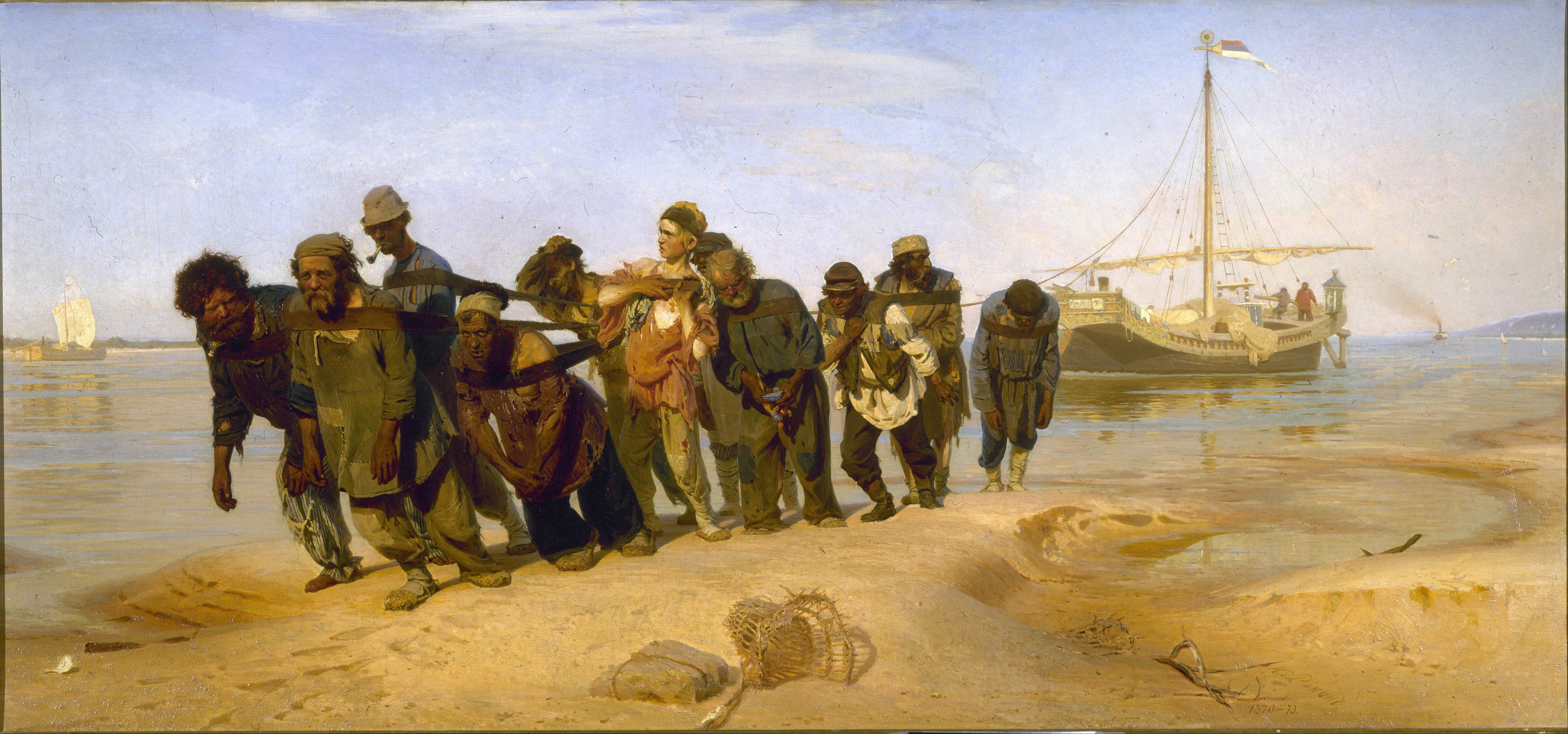
Ilya Repin · Barge Haulers on the Volga · 1870–1873 · Oil on canvas · Public Domain
c. 650 AD — Oldest known oil
based paintings: Buddhist murals in the cave complexes of Bamiyan, Afghanistan. Researchers identified walnut and poppy oil binders beneath pigments including Vermilion, Lead White, and natural Ultramarine. This discovery in 2008 overturned the long-held assumption that oil painting was a European invention.
c. 1100s — European manuscript sources (including those of Theophilus) describe the use of linseed oil as a paint medium for decorative metalwork and architectural surfaces. These early applications were not yet easel painting.
c. 1410
Jan van Eyck (c. 1390–1441) does not invent oil painting, but perfects a revolutionary stable varnish using siccative linseed oil boiled with lead compounds (litharge), ground glass, and calcined bones. This produced a binding medium of unprecedented translucency and durability. His technique of building 20+ thin glazes over an underpainting in egg tempera created realism of a wholly new order. Giorgio Vasari in Le vite (1550) credits van Eyck with the invention; modern scholarship clarifies that he perfected and systematised an existing approach.
1434
The Arnolfini Portrait (Jan van Eyck, National Gallery, London) demonstrates the full maturity of the northern Flemish oil technique: mirrorlike reflections, textile textures rendered thread by thread, atmospheric depth in shadow.
c. 1450–1500
Oil painting spreads from Flanders to Italy. Antonello da Messina is often credited with introducing the technique to Venice. By 1500, oil on canvas has displaced egg tempera as the dominant medium across Italy.
1516–18
Titian's Assumption of the Virgin (Basilica di Santa Maria Gloriosa dei Frari, Venice) marks the full maturation of Venetian oil technique: bold impasto for highlights, layered glazes for chromatic depth, warm earth tones in shadow.
c. 1600s — Baroque masters develop chiaroscuro and tenebrism. Caravaggio uses extreme light-dark contrast (tenebrism) with a single light source; Rembrandt (1606–1669) combines psychological penetration, selective impasto in highlighted areas, and glazed shadows. His Self-Portrait (1659, National Gallery of Art, Washington) shows impasto passages so thick the brushstrokes are almost sculptural, used solely where light strikes the face.
1642
Rembrandt's The Night Watch (Rijksmuseum, Amsterdam): impasto for the militia's shining armour, thin glazes for deep backgrounds. The paint film remains intact after nearly 400 years — a testament to the archival stability of properly layered oil paint.
1665
Vermeer's Girl with a Pearl Earring (Mauritshuis, The Hague): seamless blending (no visible brushwork), glazed transparencies creating the illusion of light falling through thin skin. Vermeer likely used a camera obscura to project images; his painting method reveals extraordinary optical sensitivity.
1841
American portrait painter John Goffe Rand patents the metal collapsible paint tube. Before this invention, artists ground their own pigments and stored them in pig bladders or ground them fresh daily. The tube made painting portable, accelerated colour availability, and directly enabled plein-air painting.
1860s–1880s
Impressionism. Claude Monet, Pierre-Auguste Renoir, Camille Pissarro abandon the studio convention of thin layered glazes, working directly from observation in natural light with solid strokes of unmixed colour. The portable paint tube makes this possible. Monet's series paintings (Haystacks, Rouen Cathedral) explore the optical effects of light and atmosphere across time of day and season.
1880s–1890s
Post-Impressionism. Van Gogh (1853–1890) extends impasto to its expressive extreme: paint applied in visible, directional strokes that create energy and movement independent of subject matter. His Sunflowers (1888) has paint ridges several centimetres thick, catching light as a relief sculpture.
20th century — Oil paint remains dominant through Fauvism, Expressionism, Surrealism, and Abstract Expressionism. Willem de Kooning's remark — "Flesh is the reason oil paint was invented" — captures the medium's particular affinity for the human figure. Abstract Expressionists (Rothko, de Kooning, Francis Bacon) exploit the medium's slow drying and blendability for large-scale gestural work.
1970s–present
Growing use of alkyd mediums accelerates oil's drying time. Water-mixable oil paints (Winsor & Newton Artisan) emerge for those seeking to avoid solvents. However, traditional oil paint remains the professional standard for archival permanence and optical quality.
Brands ▾
Professional / Artist Grade
Williamsburg
American, made in small batches in New York. Williamsburg grinds their pigments coarser than most brands and uses a higher oil-to-pigment ratio — the result is paint with exceptional buttery texture and colour that is almost shockingly saturated straight from the tube. Their range includes historical pigments unavailable elsewhere, including genuine Lead White, Flake White, and a Naples Yellow made from actual antimony. Not widely stocked in physical stores. Order online.
Store coming soon
Rublev Colours
American, made by Natural Pigments. Rublev is the closest thing to historically accurate oil paint available today. They source and grind genuine historical pigments — real Lapis Lazuli, genuine Vermilion, actual Malachite — and mill them into linseed or walnut oil by hand. The colours behave differently from modern synthetic pigments in ways that are immediately apparent. Used by conservators and artists serious about historical technique.
Store coming soon
Michael Harding
British, made by one person in small batches. Michael Harding grinds each colour individually to the consistency he judges correct for that specific pigment — some stiff, some fluid — rather than standardising across the range. The result is paint of extraordinary quality and significant variation. His Titanium White is considered by many professionals to be the finest available. Expensive and worth it.
Store coming soon
Blockx
Belgian, founded 1865. One of the oldest continuously operating oil paint manufacturers in the world. Blockx uses a proprietary grinding process and poppy oil for many colours — the paint has an unusually silky consistency and exceptional transparency in their glazing colours. Relatively unknown outside Europe and among serious collectors.
Store coming soon
Schmincke Mussini
German. Schmincke adds dammar resin to their Mussini formula — a technique from the Old Masters — which increases transparency, speeds drying slightly, and gives finished paint films a depth and richness that straight oil paint cannot match. The resin also improves adhesion between layers. A technically sophisticated choice for layered, glazing-based work.
Store coming soon
Winsor & Newton Artists
British, the benchmark. W&N Artists Oil has been the professional standard since 1832. Consistent, reliable, excellent lightfastness ratings, and available worldwide. Not the most exciting paint but always correct. The reference point most other brands are compared against.
Store coming soon
Old Holland
Dutch, founded 1664. The oldest continuously produced oil paint in the world. Old Holland uses extremely high pigment loads and minimal oil — the paint is very stiff, very concentrated, and very expensive. A little goes a long way. Their historical colour range includes pigments and names from 17th century Dutch painting practice.
Store coming soon
Mid Range
Gamblin 1980
American. Gamblin 1980 is a mid-range oil paint that uses single pigments throughout the range and maintains strict lightfastness standards. Excellent value for the quality. Gamblin is also the most transparent company in the industry about their pigment formulations — every colour is fully documented. A serious choice at a reasonable price.
Store coming soon
Student Grade
Winsor & Newton Winton
The most widely available student-grade oil paint worldwide. Uses hue replacements for expensive pigments. Reliable for learning and underpaintings. Not suitable for finished work intended to last.
Store coming soon
Lukas Berlin
German student grade with unusually good pigment quality for the price point. Water-mixable version also available. Honest about its formulations and a step above most student grades in actual paint film quality.
Store coming soon
Works in ekphra ▾
No works found yet. Artists using Oil Paint will appear here.
Posts
▾
No posts yet.