← Paint
PAINT
Watercolour
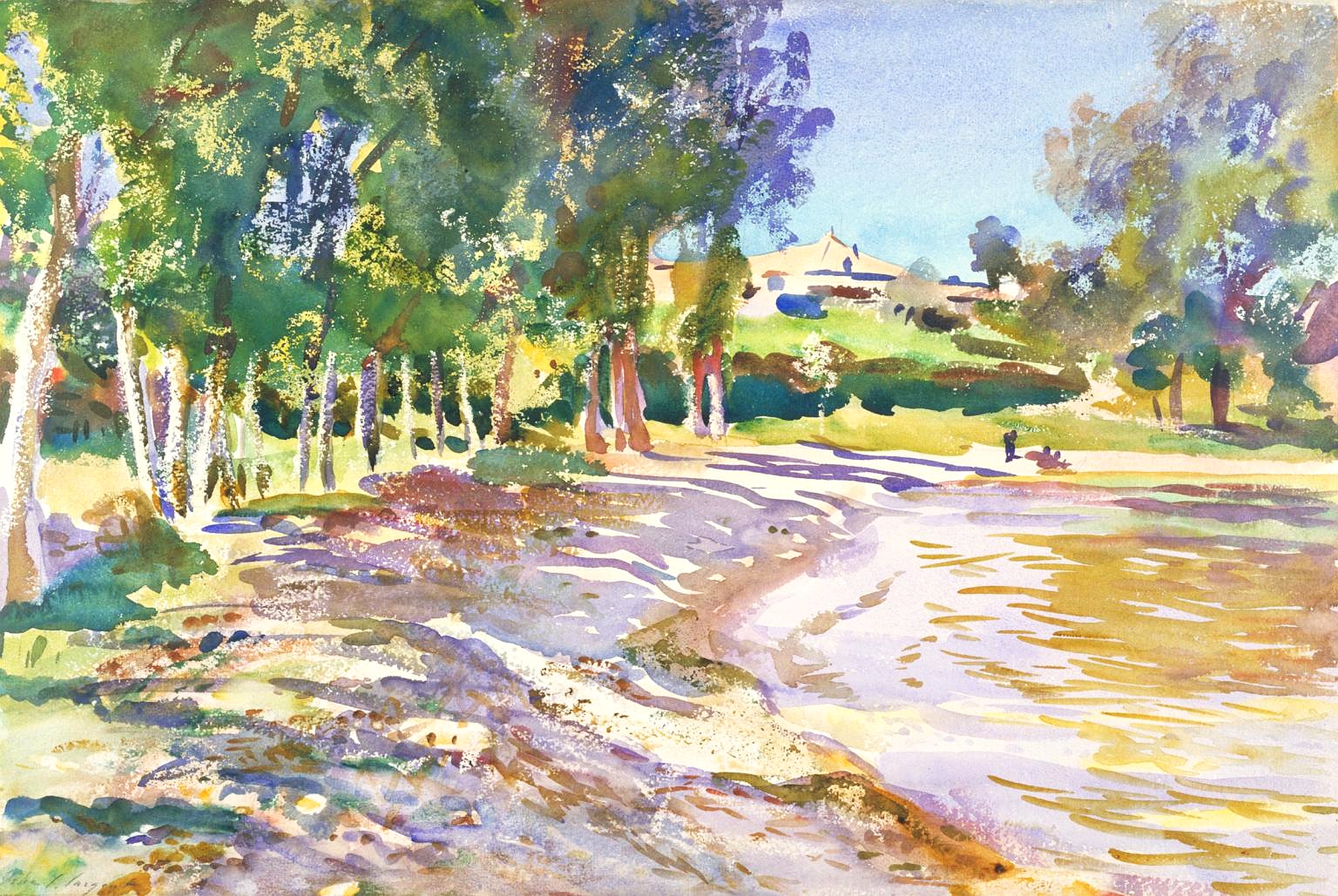
John Singer Sargent · San Vigilio, Lago di Garda · 1913 · Watercolour · Public Domain
Watercolour is the only medium where your biggest tool is restraint. Pigment ground fine and suspended in gum arabic, dissolved in water, applied to paper — and what happens next is partly yours and partly not. That negotiation is the medium.
Unlike oil or acrylic, watercolour has no white paint. The white is the paper itself. This single fact changes everything about how you think: you plan backwards, protect your lights from the start, and build darkness in layers of transparent colour. You cannot cover a mistake. You can only move forward from it.
What separates watercolour from every other medium is its relationship with light. Because the pigment sits on top of — or slightly into — the paper fibre, and the paper reflects light back up through the transparent layers, finished watercolours have a luminosity that cannot be replicated. Scanned, photographed, printed — it always loses something. The original glows.
The medium rewards artists who can think three moves ahead and let go at exactly the right moment. That combination of planning and surrender is rarer than it sounds.
Unlike oil or acrylic, watercolour has no white paint. The white is the paper itself. This single fact changes everything about how you think: you plan backwards, protect your lights from the start, and build darkness in layers of transparent colour. You cannot cover a mistake. You can only move forward from it.
What separates watercolour from every other medium is its relationship with light. Because the pigment sits on top of — or slightly into — the paper fibre, and the paper reflects light back up through the transparent layers, finished watercolours have a luminosity that cannot be replicated. Scanned, photographed, printed — it always loses something. The original glows.
The medium rewards artists who can think three moves ahead and let go at exactly the right moment. That combination of planning and surrender is rarer than it sounds.
Properties ▾
Binder: Gum arabic — the original, still the best. It gives watercolour its characteristic glossy surface when dry and controls how the pigment flows and settles.
Solvent: Water only. The ratio of water to pigment controls everything: value, edge quality, granulation, bloom.
Opacity: Transparent to semi-transparent. Student-grade paints use more filler and appear more opaque. Professional grades are near-pure pigment in gum arabic — genuinely transparent.
Drying time: 5 to 30 minutes depending on humidity, paper absorbency, and water ratio. In humid conditions this extends significantly.
Re-wettable: Yes. Dried watercolour can always be reactivated with water. This is both a strength and a vulnerability — later glazes can disturb earlier layers.
Lightfastness: The most variable of all painting mediums. Quinacridone, Phthalo, Ultramarine — exceptionally permanent. Alizarin Crimson, many organic dyes — fade noticeably within years. Always check the ASTM rating. I and II are archival. III and IV are not.
Paper weight: 300gsm minimum for serious work. Lighter paper buckles when wet. Stretch 200gsm paper before use or use blocks.
Paper surface: Cold press — textured, most versatile, most forgiving. Hot press — smooth, reveals every mark, preferred for detail. Rough — heavily textured, dramatic granulation, unforgiving.
Pigment load: The single biggest difference between student and professional grade. A professional Prussian Blue covers the same area as four times the volume of student grade.
Techniques ▾
Wet-on-wet
Pre-wet your paper with clean water, then drop pigment into the wet surface. The paint blooms and spreads in ways you cannot fully plan. Timing is everything — too wet and the pigment disperses to nothing; too dry and you get a hard cauliflower edge. The window is narrow and changes every session.
Wet-on-dry: Wet paint on a completely dry surface. Crisp edges, defined shapes, precise marks. Most finished work is a combination — wet-on-wet for atmosphere, wet-on-dry for structure and detail.
Glazing: Wait for a layer to dry completely, then apply a transparent wash over it. The colours layer optically rather than mixing. Three thin glazes of the right colours produce a depth that no single mixed colour can match. This is how luminosity is built.
Granulation: Certain pigments — earth colours, some ultramarines, a few cobalts — have larger particles that settle into the texture of the paper rather than staining it evenly. The result is a grainy, mineral quality that is impossible to fake. Daniel Smith PrimaTek pigments are specifically made for maximum granulation.
Lifting: Wet paint can be removed with a dry brush, cloth, or paper towel. Staining pigments like Phthalo Blue bond quickly and resist lifting. Non-staining pigments like Ultramarine lift cleanly even when dry. Knowing which of your pigments stain is as important as knowing their colour.
Dry brush: Load a brush, remove most moisture, and drag it quickly across textured paper. The paint catches only the raised surface, leaving broken energetic marks. Essential for suggesting water, grass, or any texture that should not look painted.
Reserving whites: There is no white paint. Plan your lights before you begin and leave the paper untouched. Masking fluid protects precise areas while you work freely around them. Remove it only when surrounding washes are completely dry.
Wet-on-dry: Wet paint on a completely dry surface. Crisp edges, defined shapes, precise marks. Most finished work is a combination — wet-on-wet for atmosphere, wet-on-dry for structure and detail.
Glazing: Wait for a layer to dry completely, then apply a transparent wash over it. The colours layer optically rather than mixing. Three thin glazes of the right colours produce a depth that no single mixed colour can match. This is how luminosity is built.
Granulation: Certain pigments — earth colours, some ultramarines, a few cobalts — have larger particles that settle into the texture of the paper rather than staining it evenly. The result is a grainy, mineral quality that is impossible to fake. Daniel Smith PrimaTek pigments are specifically made for maximum granulation.
Lifting: Wet paint can be removed with a dry brush, cloth, or paper towel. Staining pigments like Phthalo Blue bond quickly and resist lifting. Non-staining pigments like Ultramarine lift cleanly even when dry. Knowing which of your pigments stain is as important as knowing their colour.
Dry brush: Load a brush, remove most moisture, and drag it quickly across textured paper. The paint catches only the raised surface, leaving broken energetic marks. Essential for suggesting water, grass, or any texture that should not look painted.
Reserving whites: There is no white paint. Plan your lights before you begin and leave the paper untouched. Masking fluid protects precise areas while you work freely around them. Remove it only when surrounding washes are completely dry.
The artists who fight watercolour never win. The ones who last are the ones who learned to want what it gives them, not what they came in asking for.
History ▾
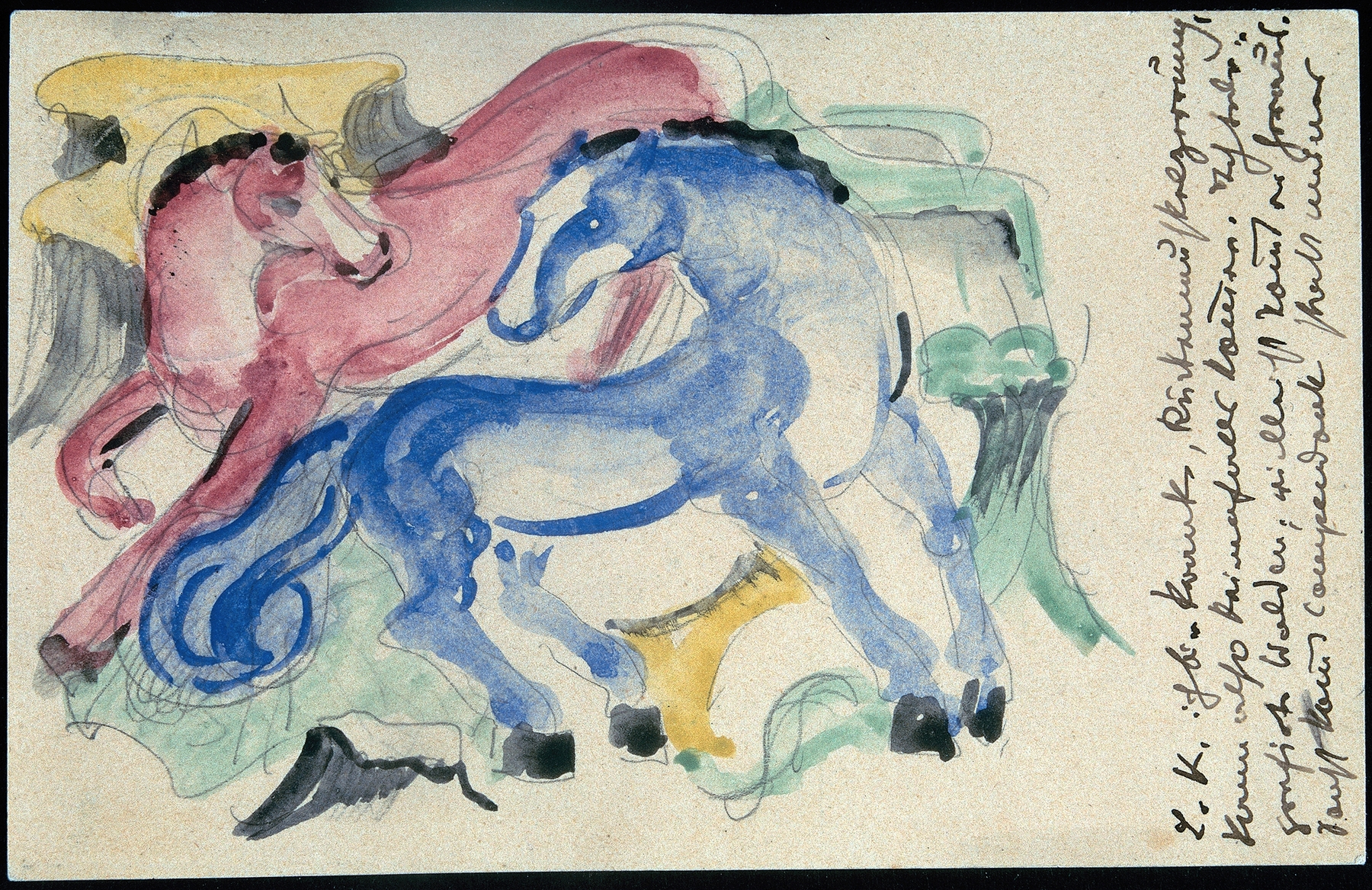
Franz Marc · Red and Blue Horse · 1913 · Watercolour · Public Domain
c. 15,000 BC — Cave painters at Lascaux use water
suspended pigments — ochre, manganese, charcoal. The oldest watercolour is also the oldest painting.
c. 3000 BC
Ancient Egyptians bind pigments in gum arabic and egg white for papyrus manuscripts. The formula for gum arabic has not fundamentally changed since.
c. 600 AD
Chinese and Japanese ink wash painting develops into a complete philosophical system. Negative space becomes as important as the mark. Western painting takes another thousand years to arrive at this idea.
1400s
European manuscript illuminators reach the technical peak of water-based painting on vellum. The Books of Hours remain among the most technically precise watercolours ever made.
1490s
Albrecht Dürer produces watercolour studies of plants and landscapes — the first major Western artist to treat watercolour as a finished work rather than a preparatory sketch.
1750s
Paul Sandby establishes watercolour as a legitimate landscape medium in Britain. Before him, it was considered a drawing tool, not a painting medium.
1804
The Society of Painters in Water Colours is founded in London. Watercolour finally has an identity separate from drawing and oil painting.
1800s
J.M.W. Turner redefines what watercolour can do. He dissolves form into atmosphere, uses the paper as pure light, and produces work of a scale and ambition the medium had never attempted. His methods are still studied and still not fully understood.
1856
Winsor & Newton begins commercial production of moist watercolours in metal pans. Consistent, portable colour becomes available to anyone. The democratisation of watercolour begins.
1900s
Winslow Homer and John Singer Sargent bring American directness to the medium — faster, looser, more gestural. Sargent demonstrates that virtuosity and spontaneity are not opposites.
2010s
The urban sketching movement and a global reaction against digital overwhelm drive a major revival. Watercolour becomes one of the fastest-growing fine art mediums worldwide.
Brands ▾
Professional / Artist Grade
Daniel Smith
American brand with the largest watercolour range in the world — over 240 colours. Their PrimaTek line uses genuine mineral pigments like Lapis Lazuli, Malachite, and Amethyst ground directly into paint. The granulation is extraordinary and unlike anything from any other brand. Widely available online worldwide.
Store coming soon
Schmincke Horadam
German precision since 1881. Schmincke uses a higher gum arabic concentration than most brands, which gives their paint exceptional flow and transparency. Colours are intensely pigmented and extremely consistent batch to batch. The gold standard in Europe.
Store coming soon
Sennelier L'Aquarelle
French, founded 1887. Sennelier adds honey to their formula instead of relying on gum arabic alone — the result is an unusually creamy, slow-drying paint that stays workable longer and re-wets beautifully. Beloved by artists who work wet-on-wet. Their colour range includes some pigments no other brand carries.
Store coming soon
Holbein Artists
Japanese. Holbein omits ox gall (a common additive for flow) and uses no preservatives — the result is a paint with a distinctly different handling quality: smooth, buttery, slightly stiffer. Exceptionally consistent across their entire range. Preferred by many illustrators and designers for its predictability.
Store coming soon
Roman Szmal Aquarius
Polish, small batch production. Almost unknown outside Europe but increasingly recognised as one of the finest watercolours made today. Extraordinarily high pigment load, unusual single-pigment transparency, and granulation behaviour that rivals Daniel Smith. Significantly less expensive than comparable professional brands. Worth seeking out.
Store coming soon
MaimeriBlu
Italian. Maimeri focuses obsessively on single-pigment formulations — most of their colours contain only one pigment, which means cleaner mixes and more predictable glazing. A favourite among artists who care deeply about colour theory in practice.
Store coming soon
Winsor & Newton Professional
British, the benchmark. W&N Professional (not Cotman) has been the reference point for watercolour quality since 1832. Consistent, reliable, with excellent lightfastness ratings across the range. Not always the most exciting — but always correct.
Store coming soon
Mid Range
QoR Modern Watercolour
American, made by Golden. QoR replaces gum arabic with a synthetic binder called Aquazol — the result handles completely differently from traditional watercolour. Dries faster, lifts more easily, stays more vibrant when dry. Either you love it or you don't, but it is worth trying at least once to understand what binder actually does.
Store coming soon
Student Grade
Winsor & Newton Cotman
The most widely available student-grade watercolour worldwide. Uses hue replacements for expensive pigments. Reliable for learning, inadequate for serious finished work. A reasonable starting point.
Store coming soon
Sakura Koi
Japanese student grade, popular in the urban sketching community for its portability and consistent handling. Good value. Limited pigment quality compared to professional grades, but honest about what it is.
Store coming soon
Works in ekphra ▾
No works found yet. Artists using Watercolour will appear here.
Posts
▾
No posts yet.